I remember a time, when my daughter was young, and we were heading home after her rehearsal for a play had ended. Someone called out a question behind me as we stepped into the crosswalk, and without a thought I looked over my shoulder to answer. Turning back around, I was face-to-face with a minivan that had been making a left turn. It had almost come right through the crosswalk, and through both my daughter and I.
By the time I turned and saw it, by the time I had even registered it, the van had already lurched to a sharp halt. Fear, sharp and immediate, stabbed at me in that moment. I still remember feeling that it was so close that I could have easily reached out my hand to touch the hood of the van. The driver, perhaps a parent of another child leaving that same rehearsal, had a look of shock on their face. I forced a tight smile, waved to say, “don’t worry, we are ok!,” and finished crossing the street. Holding my daughter’s hand a bit tighter.
Fear can be such an unpleasant experience that we might think that our lives would be better without it. But would that be really true? Looking closely, I can appreciate the value of fear. Not the experience of fear itself, but the very capacity to fear. Like a “rumble strip” running alongside a highway, it buzzes and jostles us if we drift out of the safe path. Fear grabs our body and our attention when we are face-to-face with a threat, real or imagined. We feel that rush of adrenaline and stress hormones, preparing us for a vigorous response. Our attention may narrow, drawing our focus towards dealing with the situation.
Even the very unpleasantness of fear itself can be useful, motivational – even if we are not harmed, we want to find some way to avoid these risks in the future. So really, the value of fear – as a capacity – is easy for me to understand. An important guardrail against complacency, or overconfidence.
But anxiety, that close cousin of fear, has often felt like an entirely different matter to me. The roots of fear are in the dangers that seem to be in front of us, and in something that should be dealt with. The center of anxiety seems to be somewhere else, grounded out ahead of us, in the future. Not in what is here and now, an immediate threat, but in what is coming. Or, maybe even just in what might be coming.
Our kids attended third grade at a local school only a few blocks from our home. We were very lucky, really, that it was only a short walk or bike ride to school. Once our oldest child had settled into the route, we trusted them to make that trip on their own.
Part of me, though, was never really comfortable with the idea. Like many parents of our generation (maybe of any generation?), I worried about all the things that might happen on their bike ride to school. There were no particular risks that seemed likely, but even so, there it was, a sense of unease.
My fear sprang up in the moment from seeing a van heading toward my daughter, and my anxiety radiated diffusely out of all the “maybes” and “mights” of what might happen on a bike ride to school. So, I did worry about that trip, and especially about the highway that ran between our home and the school.
I see now that at a deep level, some of my anxiety came from how I saw my role as a parent, and how I should be able to protect my children from all harms. And that is not unreasonable, really, to understand the importance of caring for the safety and wellbeing of our children. But I didn’t see clearly at the time how it could be a different thing, to believe that this meant that I should be able to prevent every danger.
There is a line from the movie, A Quiet Place, that brought this attitude into focus for me. When their children are in danger, in a moment of panic, Emily Blunt’s character asks, “Who are we if we can’t protect them?” Who are we, indeed? Her question resonated with me, and I felt it captured something true about what I felt that is meant for me to be a parent. But when we look closely, our situations were not symmetrical: Emily Blunt was protecting her fictional children (from aliens), and my kid was riding a bike to a neighborhood school.
Anxiety is not the only flavor of suffering in our lives, but it is an important one. Sometimes, it feels like we live in an anxious time. Triggers for anxiety can come up suddenly and easily. So much so that we might feel justified to believe that a threat may jump up at any moment: in each text notification, in each email, or even in the silence (of an expected call).
Do we need this? To be afraid of all of that which might not even be a real danger, and might not even happen? On the one hand, it seems like time and energy wasted. On the other hand, even if the risks seem unlikely, they can be difficult to set aside.
Sometimes, I feel that we approach anxiety – or any negative part of our experience – as a defect, or a corruption of our natural state. As a neuroscientist, though, I feel that this view doesn’t really fit the reality of our lives.
Pain offers a good comparison. Pain, especially when extreme and unrelenting, can be a significant source of suffering in our lives. But at its most basic level, pain exists to serve a function. Pain pulls our attention to damage in the body, moves us to take steps to protect ourselves and to allow space for healing. I don’t see any particular reason to celebrate being in pain, but I can appreciate how pain is bound up in how the body takes care of itself.
Just like the experience of pain, anxiety is a natural part of experience, and not necessarily an error. After all, dangers can (and do) come suddenly and unexpectedly. Looking ahead for those risks, we may be better able to avoid the danger, or better prepared to deal with it when it arrives. Fear has its use when a van is heading towards you and your child, and anxiety has its use when it brings us think carefully about if our child is safe making their own way to school.
And so, we are not really surprised to find that just like pain, the capacity to feel fear and anxiety depend on specialized circuits in the brain. You might be familiar with the amygdala, a pair of almond-shaped structures that sit deep in brain, roughly behind our temples. The amygdala are critical in recognizing the emotional color or tone of a situation, such as recognizing threats, and helping to start our efforts to respond. People who lack amygdala are largely freed from the experience of fear, even in very intense situations (one person was robbed at knifepoint, and felt no panic).
Another brain structure, the hippocampus, is well-known for its role in learning and memory (for instance, problems in the function of the hippocampus are a key cause of the memory impairments that are seen in the early stages of dementia). But, the hippocampus is also involved in emotion, and that part of it is tightly connected to the amygdala. Recent research with mice has shown that the cells in this part of the hippocampus are important for the experience of fear and anxiety. Largely separate sets of cells are active for each emotion: fear and anxiety turn on different circuits in the hippocampus of rats, suggesting that even in rats, the ability to be anxious is built into the brain.
If anxiety is a natural part of our experience, if it serves a function, then should we simply accept anxiety as right and inescapable? Again, the comparison to pain is helpful. Pain serves a useful function when it calls our attention to injury, helps us protect against further damage, and supports our healing. People who lack the capacity to feel pain are at great risk to suffer grave injuries. And also, pain that becomes too intense may interfere with our ability to function in our life. In these cases, pain may no longer useful. Like pain, anxiety can serve an important function, helping us to avoid threats that may be ambiguous, or which may be coming in the future. But, our anxiety can be misaligned to our reality.
Excessive anxiety can spring from many places, and one source can be worrying – the thinking that we do around potential misfortunes (like an injury, illness, financial challenges, relationships, etc.). Worrying is a part of anxiety (like physical symptoms that we are likely familiar with). But, this type of thinking – coming back again and again to the negative things that may occur – can exacerbate and prolong anxiety. Like giving air to a flame, our worries can intensify our anxiety, letting it burn hotter and longer.
Researchers who have looked at the question of why people worry excessively have proposed that this type of thinking is a doomed attempt to apply problem-solving strategies at the wrong moment. In this view, we are essentially to trying to take control of that which is beyond of our control.
Other studies have suggested that worrying might actually be a strategy that people can use, largely unconsciously, to protect against the shock of a negative experience. This work, focused on the study of contrast avoidance, accepts the truth that we enjoy positive experiences and avoid negative ones. But, it adds that we are also motivated by the contrast when our experience changes, and the size of the shift (how much better we feel, or how much worse we feel) is important. We not only seek out pleasure, but sharp, large increases in pleasure. We not only avoid discomfort and pain, but we avoid sharp negative shifts in our emotional experience.
So in a strange way, worrying can “help” us by blunting these contrasts. By keeping ourselves in a mild negative state, if something unpleasant were to happen, the impact will be blunted (we don’t feel that much worse). And, if something positive happens, then it could feel even better than if we had already been in a relatively content state. People who are more sensitive to contrast avoidance may find themselves worrying, almost as a way to brace themselves. The emotional equivalent of tensing up to prepare for the negative impact of adversity.
One morning, back in that year of third grade, my wife got a call from the school principal. Don’t worry, he told her, everything is fine. They had our child at school, he continued, which was the right thing to say in the moment. But could anything be less reassuring to hear as a parent? After all, why wouldn’t you have our child? Why wouldn’t everything be fine?
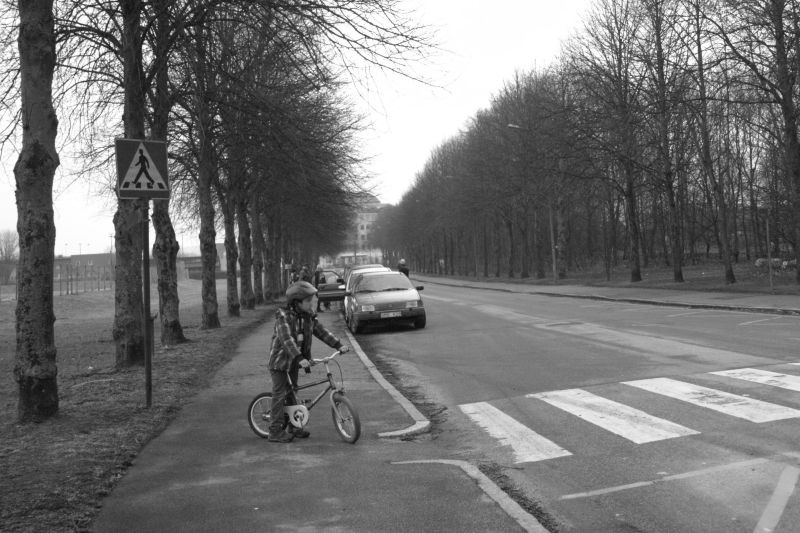
Earlier in the morning, a car had failed to stop while our child was crossing the highway. We never learned exactly what happened, but the driver didn’t notice the crossing guard, not until it was almost too late. Fortunately, the car did lurch to a halt. But not before sliding into the crosswalk, and pushing over our child on their bicycle. The driver quickly fled the scene, without stopping to see if everyone was ok, and was never identified.
Our child picked themselves up, and finished the ride to school. Put their bike away and quietly went off to class. No one at the school knew what had happened, until the crossing guard came in after his shift, asking at the front office if the child who had biked away was ok. He quit the job later that week. I think his wife had been there that day, waiting in their car, and had seen it all. Both were shaken, and I can’t blame them for not wanting to continue. I’m glad he was there, though, and that he did his best in a tough moment.
For the rest of that year, I walked with our child to school. I can say that I did it for them: even with a new crossing guard, I don’t think they ever felt entirely safe. Part of it came from me, though, feeling the need to manage my own anxiety.
To be able to recognize anxiety, to understand it, and to be better able to deal with it has been an important part of my own life and my practice. Sometimes, my own anxiety has been out of focus, something I can’t quite see clearly. I don’t think I even could see it clearly, I couldn’t recognize it, until I saw anxiety in other people. Saw the ways in which one can be unsettled, uneasy, in ways that seem out of proportion to the danger. Even after I could recognize anxiety, I’ve missed it in my own life, only able to glimpse the shadow of my own anxiety where it falls in my life: in the thoughts that keep turning back to a concern, in vague sense of unease, some new difficulty in sleeping.
Other times, when the danger falls on us, when we get the call that we’ve been dreading, I do see that some part of me feels vindicated. See? that voice says, quietly, I was right to worry, danger is everywhere, and only looking for some unguarded place to land.
Both kinds experience – the anxieties that are out of focus, and the worries that feel vindicated – have each been obstacles for me at times. When my anxiety floats out of the frame of my awareness, it can be difficult to see all of the ways it distorts my life. Pushing me in a directions I really wouldn’t have chosen – to be overly cautious, defensive, wound too tightly. It’s a constricted way to live, one that makes it difficult to enjoy what is present now, and to be open to finding solutions to the problems that are most likely to manifest.
When my worries end up feeling prophetic, then that justifies me to continue to be overprotective, pessimistic, to spend too much time focused on everything that I might lose. But, even if the worst really does come to pass, what will I have I achieved by practicing that loss countless times in my mind?
If worry and anxiety are a serious part of your life, I don’t know of any better place to start than working with a professional. Such as a therapist who can provide an outside perspective, someone who understands the ways that anxiety can trap us.
For my own, (usually mild to moderate) anxiety, I’ve found that just learning to notice how anxiety shows up in my own life, in my body, emotions, thoughts, has been very helpful. When I can’t see it, anxiety smolders outside of the frame, under the leaves. And sometimes, the feelings of anxiety themselves – constriction, tingling in the body, restlessness, and such – can feel like a threat, leading all of these sensations to intensify.
So, exploring being open to just noticing the sensations that come up with anxiety in an open way has been a useful first step for me. Working to be aware of these sensations, but always with a spirit of curiosity, interest.
At the same time, I might try to bring my attention also to the sensations of breathing (which has long been an important anchor for me in my meditation practice), starting with a couple of deep, abdominal breaths. And, I might also let attention be very broad, and open to sensations from throughout the body, and all of the senses (rather than focusing narrowly on any unpleasant sensations that may be coming from anxiety).
I also give some attention to the roots of my anxiety, down in the thoughts that might be driving or sustaining my unease. Sometimes, those thoughts are very clear, like when a storm came through our area the other day. My spouse and I watched uneasily as an ominous cloud pass by to the north of our home, not quite sure if we should move down to our basement for shelter.
Other times, they may be unclear, hanging somewhere outside of awareness. Then, I’ll try to be more open to noticing where these feelings are coming from, but in an easy, curious way. Maybe there is an email that I need to send, but am dreading. Or a concern about my health or that of a loved one. Or maybe a call that I am expecting, but has not come in.
Feeling for the root of anxiety, I might also notice some tension that comes from a need to control this situation (like I have felt as a parent). Or, any sense that I might be bracing myself for some potential threat (when I worry that a loved one might experience some setback or difficulty).
Exploring anxiety in this careful, direct, and intimate way has been an important first step for me in working with it more skillfully. I try to also be patient, knowing that even if I can see the roots, those difficult feelings may not immediately evaporate. Some of my patience comes from a trust that no matter how it feels in the moment, it will pass eventually. That can help me to accept the discomfort in the moment, while also still looking carefully at the situation.
In the end, if I can avoid the extremes of an avoidant withdrawal on one hand, and a panicked restlessness on the other, I might be better able to judge the challenge in front of me, and plan a better path forward.