Some time ago, I remember being in a class when I started training to teach mindfulness-based stress reduction. In one exercise, each of us were invited to share and reflect on our deepest fears. I have no idea what was on my mind that day, but one person’s response caught me, and has stuck with me since. Time, was their biggest fear. And especially a sense that time was always passing, and a dread that came as it seemed to be draining away.
I could understand that kind of anxiety, and I had felt similarly at points in my life. It can be a cold truth to accept the fact that our time here, or our time with those that we care about, is limited. But in my meditation practice, I’ve also been surprised at how my own sense of time has shifted, or at least feels differently to me today (and I’ve written about how I’ve explored our fluid sense of time in meditation practice).
I’ve noticed more and more how often it is that people say that time passes swiftly – that people find themselves surprised as another day, week, month, year has come and gone. In those moments, I find myself resisting a bit, leaning towards pushing back, because that doesn’t ring true for me. And, I certainly don’t want to invalidate how another person feels, but also I want people to be open to asking if there are other ways to experience the passage of time.
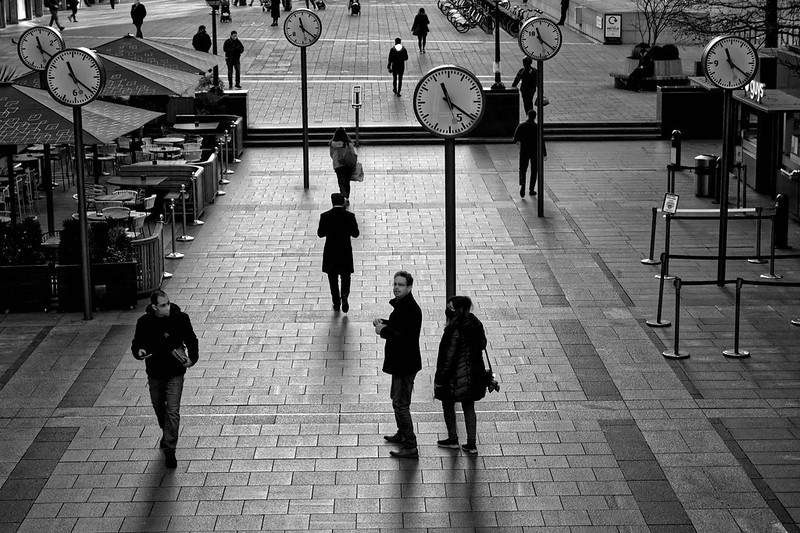
For a while now, at least several years, I’ve felt that time generally passes slowly. Not in a sense of being tedious, like how one might feel when impatiently waiting to get out of some unpleasant situation, or to get on to something that seems more interesting. For me, time often feels to move slowly, like a thick honey pouring out of a jar. Leisurely, richly. That is often true for me in meditation, and especially at many points during retreats, but that is also true of my daily life.
What this has impressed on me is that the fact that can I feel this way about time says something important about how the time that we live – our subjective, felt sense of time – is fluid.
Time as measured by the clock is certainly real, or has its own reality, and it follows its own rules. But the time that is actually important to my own life is the time I experience directly. And, I’ve seen in my own practice how flexible that sense of time can be.
As a neuroscientist, I’m also very interested in knowing more about why our sense of time can feel so expansive, or how a moment can feel timeless. So, I was very interested when I came across a recent episode of Dr. Neil deGrasse Tyson’s StarTalk podcast. In that episode (see the link below), Dr. Tyson interviewed Dr. David Eagleman, a neuroscientist at Stanford University.
In the interview with Dr. Tyson and his co-hosts, Dr. Eagleman covers a range of fascinating topics, and they come around to the perception of time in the second half of the show.
Dr. Eagleman talks about how in intense moments (like a car accident) people can often feel like time moves very slowly. And, we might think that in these moments, perhaps our thinking has sped up, letting us observe the situation more clearly, and maybe notice details that would otherwise slip past too quickly. But, can we really study moments like this, to understand something about our perception of time?
Dr. Eagleman described several research studies in this area, that pry apart what really is happening in moments when time appears to slow down. In one fascinating study that his lab conducted, volunteers were dropped about 150 feet into a net. Essentially, this study involved dropping people from the height of a 12 story building. This was for science, of course, and not just for the amusement of the researchers!
The participants in the study were trained to do a task that measured their ability to pick up on the passage of time, and were tested before and during the drop, to test the limits of the shortest intervals of time they could perceive. If their thinking really had sped up, perhaps they would be able to notice even shorter slices of time during the drop, compared to when they were standing safely on the ground.
Overall, people did feel that time seemed to slow down when they were falling into the net, but their accuracy on the time perception task didn’t change. So, while they felt time had been moving more slowly, it was not the case that they were able to notice shorter slices of time.
The research supports the idea that time did not really slow down for them (or their thinking didn’t necessarily speed up), but they felt like it had when they looked back at their memory of the fall to judge how long it had lasted.
Overall, the best explanation for why time seemed to move slower during the fall was that they had made more memories (essentially of the individual memories of each moment of the fall) compared to the control condition.
In intense moments, such as being in free fall from the height of a 12 story building, areas in the brain such as the amygdala activate many of our bodily reactions, and can heighten memory systems that take note of the details of the experience. This can be useful, as those details may be helpful if we find ourselves in a similar situation in the future (or to avoid it!). When we think back, the richness of those memories from an intense moment, compared memories for our regular, everyday experience, makes it feel like they must have lasted longer.
Dr. Eagleman made an interesting point, that this approach can also explain why many people feel that time moves more slowly as we age. As we gain more experience, more and more of daily life can feel like routine, and we may not direct much attention to everyday events. Looking back, our memories at this time may be more generic, and less granular, when compared to the memories of our youth, making it feel that time is moving ever more swiftly.
I appreciate this work, as it seems to fit with much of my experience in meditation, and in my daily life. Although, I do feel that during a retreat, there are moments that feel that they more timeless (more outside of time) in the moment that they are being experienced. But that may be a situation somewhat different from what Dr. Eagleman is describing. Perhaps this involves a situation where the part of ourselves that is looking ahead to the future or back to the past is a bit more quiet than normal.
But, during meditation and in my daily life, there is often another sense, that each passing moment is rich, and full, and worthy of attention. To me, this seems to fit with his research on the expansion of time in intense moments, as this attention, or even a kind of savoring, of regular experience likely leads to a similar expansion of the memories that are available when I think back on a day, week, month, or year.
And, I would say that the most important lesson for me about this research is not that the lengthening of time during a crisis is some kind of trick of the mind. Or that it is just an illusion. Rather, the real lesson for me is that the feeling that time is moving quickly is the real illusion, or delusion. And, I have appreciated how it has been easier for me to see life from a different position in recent years.
This feeling that time moves slowly is not something that I have been reaching for, or some goal that I am working towards. Rather, it is a feeling that seems to come from exploring what it means to be really present with each moment of life. It can feel like we are living in an age that celebrates being anywhere but settled peacefully here, where we are. So, for a long time it was difficult for me to see that there was an option to let go of living in my thoughts, of the future, of the past, of fantasy and to be comfortable right where I am. Balanced, but without falling into stagnation or complacency.
I really do feel that the time that we live in is rich, and infinitely deep, and that we can become more open to experiencing it that way. As Scott McCloud wrote in his graphic novel, The Sculptor, “Every minute is an ocean… Let them in, let them all in…“